

This year marks the 250th anniversary of the Declaration of Independence, a document celebrated as the United States’ founding charter of freedom. Under the banner of “Freedom 250,” the Trump administration and its private-sector partners have been seizing the anniversary as an opportunity to advance an amnesiac view of the past: one grounded in the active erasure of the histories of racism, exploitation, enslavement, and settler-colonial dispossession that lay at the nation’s foundations.
In this context, we recently hosted “The Other 250: America from Below,” a virtual roundtable on the contested terrain of America250—and the counter-histories that can help us confront the authoritarian politics of the present.
Watch the recording, read highlights, and explore resources on the struggle over U.S. history from below.
Speakers:
- Rebecca Nagle (Cherokee), award-winning journalist, author, and host of First America
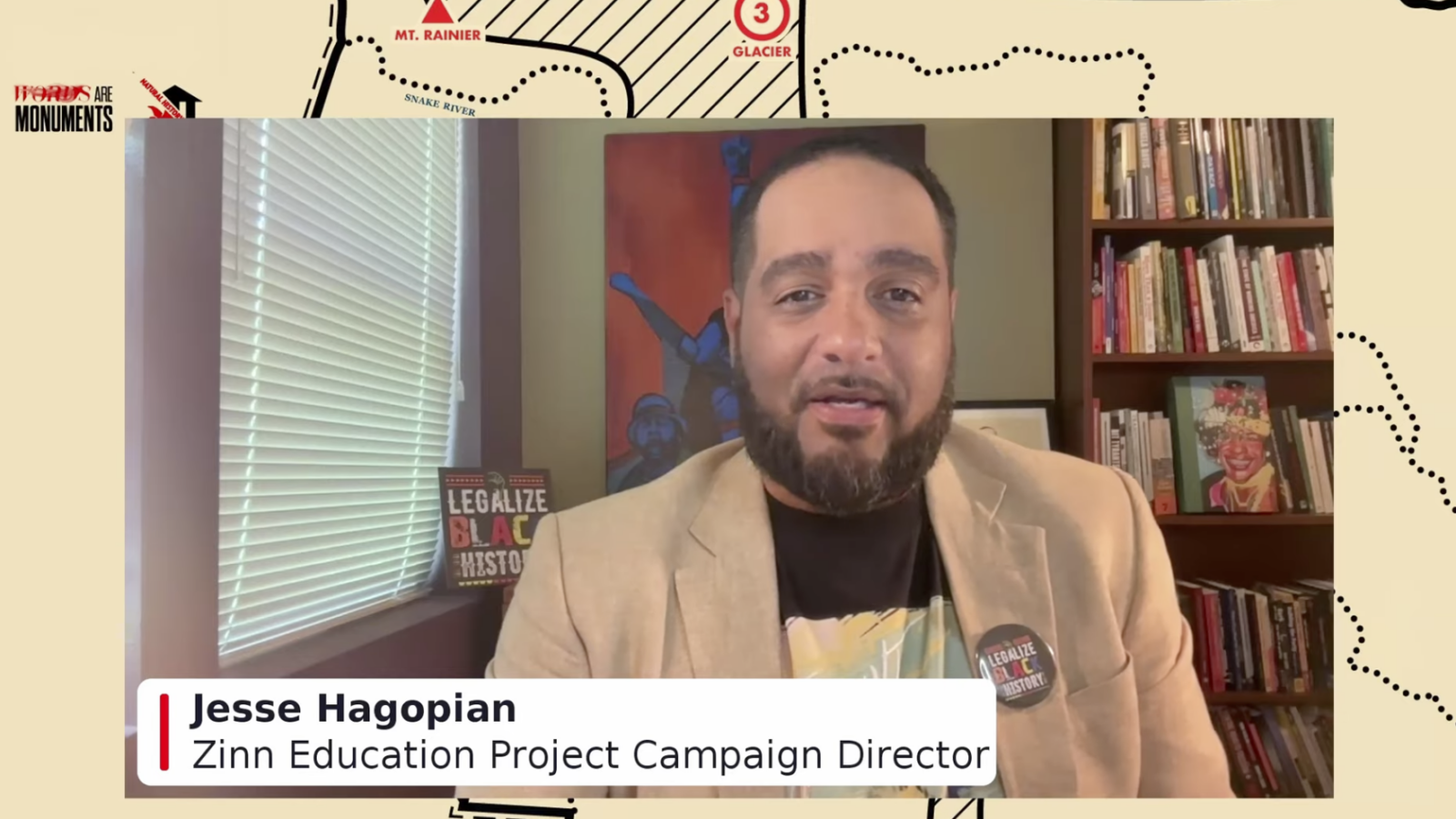
- Jesse Hagopian, educator, author, and curriculum justice advocate with the Zinn Education Project
- Derek Alderman, cultural and historical geographer specializing in place names and memorial activism
- Beka Economopoulos, Executive Director of The Natural History Museum
Moderator: Steve Lyons, Research Director at The Natural History Museum
This event was part of Words Are Monuments, an event series on place names, public memory, and the politics of commemoration.
Made possible with support from the Mellon Foundation and 4Culture.
Roundtable Highlights
From bans on textbooks to attacks on museums and public history, the America of “Freedom 250” is an obsessively pruned landscape—one cultivated to erase both the violence that made the nation and the movements that have always exceeded it.
Why is control over the past so important to authoritarian politics? And what does it look like to push back?
Placing the official commemorative narrative under the microscope, the roundtable explored why the current federal administration is targeting institutions and infrastructures of public memory, what the official story is seeking to obscure, and what other narratives might help us orient our struggles against fascism today.
Drawing on her new podcast First America, Nagle turned to the founding myth of American independence, arguing:
“The most persistent myth about the founding that we need to interrogate as a country at this moment is the idea that our founders created a democracy. They did create a democracy, but they also created an empire.”
For Nagle, this observation has clear present-day implications. Recognizing that the “life, liberty, and pursuit of happiness” was premised from the outset on the subordination of others helps us see that the authoritarian politics embodied by the Trump administration as structural and longstanding—not a temporary aberration that can be resolved by electoral means alone.
Hagopian put the central question plainly: “Trump’s Freedom 250 campaign asked us to celebrate 1776 without asking the most important question: freedom for whom?” As a public school teacher with decades of classroom experience, he emphasized how the Declaration tends to be taught in ways that portray the forms of domination and dispossession on which the nation was built as innocent, inevitable, or simply products of their time. By attuning ourselves to the world-transforming struggles of oppressed people beyond the boundaries of the United States, he argued, we can unsettle the sense of inevitability that serves only to pacify our desires for a more just world.
Alderman, a geographer specializing in place names and memorial activism, underscored how the work of freedom-making is inscribed in place. He highlighted the role of “memory workers” in bringing forward counter-narratives of struggle that remain vital today:
“We need to remember the rememberers—because with those people come lessons for us about how to do the work we need to do right now.”
Finally, turning to the institutions and infrastructures that support this kind of “memory work,” Economopoulos stressed that “we can’t rely on institutions to do this work for us, but neither can we cede institutional resources, legitimacy, and the infrastructure they provide.”
Reflecting on The Other 250—the counter-atlas launched by The Natural History Museum in response to the official Freedom 250 narrative—Economopoulos argued that it was precisely because “the field of political possibility is narrowed” that we must build alternative institutions and infrastructures capable of “returning those suppressed experiments and relationships and refusals and victories to the realm of the imaginable for us all.”
This insurgent institutionality is already taking shape. Alderman pointed to spaces like the Beck Center in Knoxville, Tennessee, which is committed to telling the human story of urban renewal so descendant communities do not forget the injustices they inherit. It is also visible in the Teach Truth movement Hagopian is leading with the Zinn Education Project; in public-education projects like Nagle’s First America, which asks us to see the founding of the United States with new eyes; and in The Other 250, whose dozens of contributors insist not only that ‘freedom-making’ is an ongoing process, but that it is rooted in place.
Although we ran short of time before taking audience questions, one felt too important to pass by:
“What changes, practically speaking, when we DO expand our histories?”
Although we could not pose it directly, each panelist answered it in their own way, helping us to see that everything changes when we understand ourselves not as protesters speaking truth to power but as historical actors, making history from below: from our collective consciousness to our strategic insight, to our ability to identify the correct target, to our capacity to build solidarity in fidelity to the ancestors who came before us.
Resources & Learn More
The Other 250, a project of Words Are Monuments
- Words Are Monuments — an initiative by The Natural History Museum supporting grassroots efforts to restore or reimagine the names of historic and sacred places.
- The New Frontier: Place Names, Power, and Political World-Building — a four-part series on the changing stakes of U.S. place-name campaigns.
- The Other 250 — a counter-atlas of place names, contested landscapes, and living struggles; includes an open call for place-name stories.
Counter-Maps, Monuments & Place-Based Projects
- Save Our Signs — a crowdsourced public archive of National Park Service interpretive signs, assembled in response to Executive Order 14253.
- Olympia’s Hidden Histories walking tours — story-map walking tours produced by Evergreen State College students with Art Forces.
- The Botany of Nations: Indigenous Ecological Knowledge and the Lewis and Clark Corps of Discovery — at the Academy of Natural Sciences of Drexel University through February 2027.
- Equal Justice Initiative Legacy Sites — the National Memorial for Peace and Justice, naming more than 4,400 Black Americans killed in racial terror lynchings between 1877 and 1950.
- Declaration House, by Sonya Clark — a Monument Lab project centering Robert Hemmings, whom Jefferson enslaved and who accompanied him in Philadelphia in 1776.
- Monument Lab — the Philadelphia nonprofit public art, history, and design studio.
- Atlas of Derogatory Landscapes — Ruben Hamelink’s photographic survey of the 1,400-plus U.S. places whose names contain racial slurs.
- The War on LGBTQ+ History — OutHistory’s running record of attacks on LGBTQ+ history.
- The Flight of 1877 — the 126-day, 1,170-mile Nez Perce flight; the Forest Service’s two-sided map shows the route against 1877 terrain and the shifting treaty boundaries.
Campaigns & Organizations
- We Want More History — a national day of history in public, September 26, 2026, organized by the Organization of American Historians.
- Zinn Education Project — coordinated by Rethinking Schools and Teaching for Change.
- Black Education Matters Student Activist Award — funds student organizing in Seattle Public Schools.
- National Association of Tribal Historic Preservation Officers — supports Tribal historic preservation programs and advocates for Tribal sovereignty in national preservation law, policy, and funding.
- The Coalition to Dismantle the Doctrine of Discovery — organizing the Christian Church to reckon with the extinction, enslavement, and extraction carried out in its name on Indigenous lands.
Podcasts
- First America — Rebecca Nagle’s six-episode series on how the founders’ treatment of Indigenous nations — and their resistance — shaped U.S. democracy.
- This Land — Nagle’s ongoing series on Federal Indian law and tribal sovereignty: “How a string of custody battles over Native children became a federal lawsuit that threatens everything from tribal sovereignty to civil rights”.
- The Red Nation Podcast — Indigenous liberation politics, from the organization co-founded by Nick Estes. “Oñate: the Zombie Conquistador Symbol That Just Won’t Die” — with Christina Castro, on the New Mexico statue fight.
Books
- Teach Truth: The Struggle for Antiracist Education (Haymarket, 2025), by Jesse Hagopian — on the movement to defend honest history in the classroom.
- Jesse Hagopian’s edited collections: More Than a Score (Haymarket, 2014), Black Lives Matter at School (Haymarket, 2020), Teaching for Black Lives (Rethinking Schools, 2018), and Teacher Unions and Social Justice (Rethinking Schools, 2021).
- By the Fire We Carry: The Generations-Long Fight for Justice on Native Land (Harper, 2024), by Rebecca Nagle — the land dispute behind McGirt v. Oklahoma.
- Our History Is the Future (Haymarket, 2024), by Nick Estes — Standing Rock understood within the long tradition of Indigenous resistance.
- The Salish People and the Lewis and Clark Expedition (University of Nebraska Press) — the expedition retold by the Salish-Pend d’Oreille Culture Committee and Elders Cultural Advisory Council.
- The Counter-Revolution of 1776: Slave Resistance and the Origins of the United States of America (NYU Press, 2014), by Gerald Horne — the Revolution as, in part, a counter-revolution to preserve slavery.
- Bicentennial: A Revolutionary History of the 1970s (University of Chicago Press, 2026), by Marc Stein — how the 1976 bicentennial was celebrated and protested, from official pageantry to counter-bicentennial organizing. “Queering the Bicentennial: Patriots, Protesters, Pornographers, and Profiteers in the 1970s” — Stein’s OutHistory exhibit on the same subject (free, no paywall).
- Abolition Geography: Essays Towards Liberation (Verso, 2022), by Ruth Wilson Gilmore — freedom as something made and held in particular places rather than declared in the abstract (full text is free online).
Articles & Essays
- “500-Year-Old Slave Revolt of 1526 Redefines Freedom as US Turns 250” (Truthout) — the first recorded slave rebellion in what is now the United States, 250 years before the Declaration.
- America 250: A Revolutionary Perspective — conversations, essays, and videos on the Declaration of Independence amid a resurgent far right, from the Community Environmental Legal Defense Fund.
- “Freedom is a place: Ruth Wilson Gilmore and abolition geography” (GEOUSP, 2024).
Classroom Resources
- Erasing the Black Freedom Struggle: How State Standards Fail to Teach the Truth About Reconstruction — on how, and whether, Reconstruction is taught in U.S. schools.
- Zinn Education Project:
- Teaching the American Revolution on America 250 — inquiry questions, lessons, K–12 book lists, and primary sources from the Zinn Education Project.
- “Founding” Documents We Don’t Learn About — the founding-era documents left out of the textbooks.
- “Hundreds of Teachers Sign Up to Teach Truthfully on Constitution Day”
The Official 250 & the Policy Record
- Executive Order “Restoring Names That Honor American Greatness” — directs the naming and renaming of geographic features in the United States, signed on the administration’s first day back in office in 2025.
- “Place Name Reconciliation Guiding Visions and Principles” — the nation’s first set of place-naming reconciliation principles, lead-authored by Derek Alderman (Parks Stewardship Forum, 2026).
- Freedom 250 — the White House Task Force initiative, which absorbed federal semiquincentennial resources in 2025.
- America250 — the separate U.S. Semiquincentennial Commission, established by Congress in 2016, and the America250 Foundation.
- “Trump launches America’s 250th birthday celebrations with partisan attack” (The Guardian)
- Proposed IRS regulations on educational institution 501(c)(3) status — would create a pathway to denying nonprofit status to educational organizations that do not conform to the administration’s anti-DEI positions.