

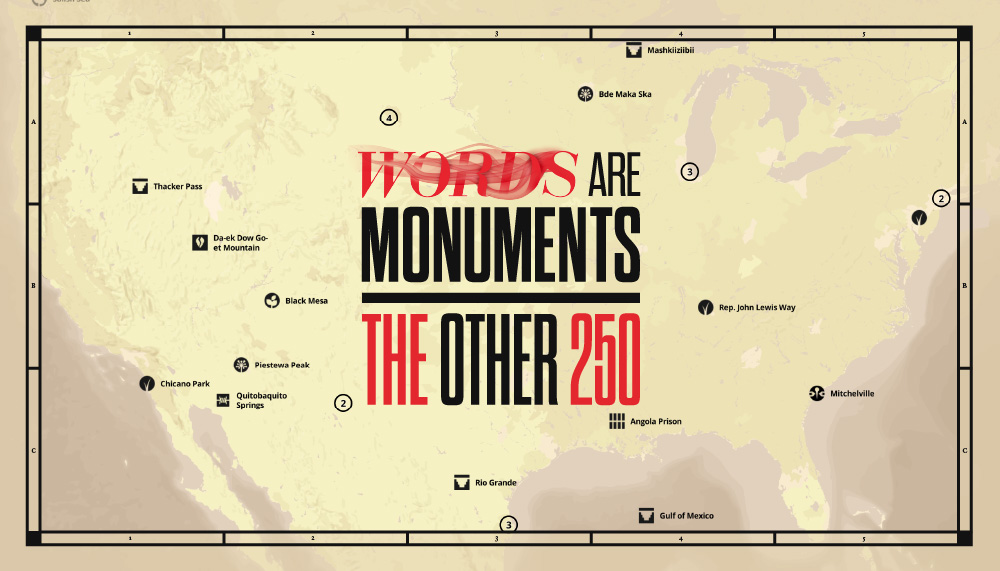
As the patriotic pageantry builds toward July 4th, we’re launching The Other 250, a counter-atlas of the country told through the names on its map.
Freedom 250 has drawn its own map. The Department of Transportation’s Great American Road Trip lays out 250 sanctioned stops—a version of America sponsored by Shell, Toyota, and Boeing, and narrated by Transportation Secretary Sean Duffy and his family from the front seat.
Readying the commemorative road: an executive order renaming Denali and the Gulf of Mexico to “honor American greatness,” interpretive signs pulled from public sites, school curricula censored, and museum content stripped or rewritten. A single sanitized story, imposed from above.
The Other 250 invites you to take a tour through former prisons reclaimed as sites of Indigenous self-determination, sacred landscapes threatened by extraction, Black freedom towns nearly erased by development, queer and trans geographies of joy and resistance, and rivers remembered not as borders but as kin.

Highlights from the Map
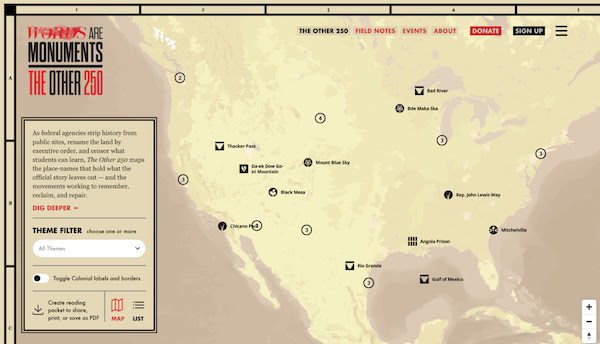
The Other 250 brings together stories of naming and renaming across Indigenous sovereignty, Black geographies, immigrant memory, labor struggle, incarceration, environmental justice, militarized borderlands, and queer and trans life—showing how place-names encode worldviews and histories that continue to shape present-day struggles over land, power, justice, and belonging.
Explore highlights from the map:
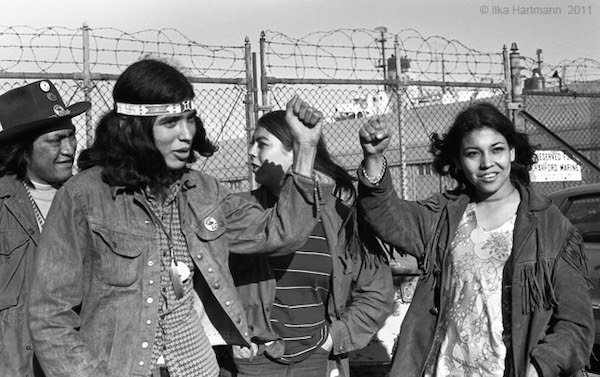
Alcatraz Island — writer and filmmaker Julian Brave NoiseCat revisits the 1969–71 occupation, when Indians of All Tribes held the former federal prison for nineteen months and reclaimed it as Native land. As the current president floats reopening Alcatraz as a working prison, this story insists on Alcatraz as a symbol of Indigenous self-determination.
Angola Prison — writer and racial, economic, and labor justice activist Kim Diehl traces the name “Angola” from plantation slavery to prison labor, immigrant detention, and the carceral geography of the U.S. South.
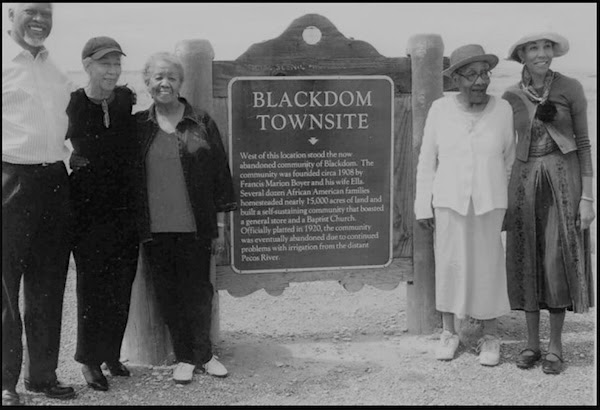
Blackdom — historian Darold Cuba restores Blackdom, New Mexico, to the map: not as a “ghost town,” but as a Black freedom colony, landholding project, and counter-cartographic claim on a future.
Black Mesa — Marie Gladue, Big Mountain resident, matriarch, pastoralist, and Executive Director of Hozho goh Nahata, recounts Diné resistance to forced relocation and mining on Dził Yíjiin, and the work of restoring Indigenous place-names, stories, and relationships to land.
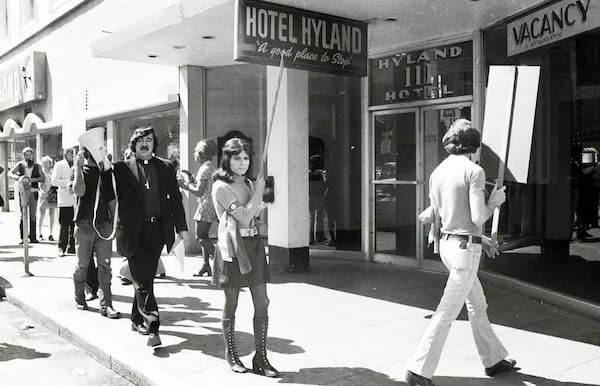
Compton’s Cafeteria Riot Site — historian and filmmaker Susan Stryker tells the story of trans and queer resistance in San Francisco’s Tenderloin, three years before Stonewall, and connects it to policing, incarceration, and abolitionist possibility.
Gulf of Mexico — geographer Zoltán Grossman unpacks Trump’s attempted renaming of the Gulf of Mexico as “Gulf of America,” revealing how nationalism, extraction, and mapmaking converge in the politics of place.
Rep. John Lewis Way — Professor of African American and Public History Learotha Williams, Jr. follows one of Nashville’s most visible monuments to the civil rights movement, a street name that honors John Lewis, while exposing the ongoing struggle over what, and whom, public memory celebrates.
Rio Grande /Atmahau Pak’na — Juan Mancias, Tribal Chairman of the Carrizo Comecrudo Tribe of Texas, writes of the river not as a border, but as a relative, a memory, and the living vein of an ancestral homeland.
Starbase — In 2025, SpaceX employees voted to incorporate Starbase, turning a launch site into a company town where the corporation is not only the employer, but the government. The name imagines a future on Mars, while the land it occupies is Esto’k Gna homeland, more recently known as Boca Chica.
Thacker Pass /Peehee Mu’huh — Max Wilbert and Bhie-Cie Zahn Nahtzu of Protect Thacker Pass write of a sacred Paiute-Shoshone landscape, a massacre site, and a struggle against industrial lithium extraction.